What a General Manager's homework looks like in 2026
A fourteen step n8n workflow from the first course in the Foundations program: sales data in, orders split and totalled, delivered orders summarised by region, two reports out. Training data, not a live system. The point is that a manager who can read this diagram can argue with it, and knows when a vendor is overselling.
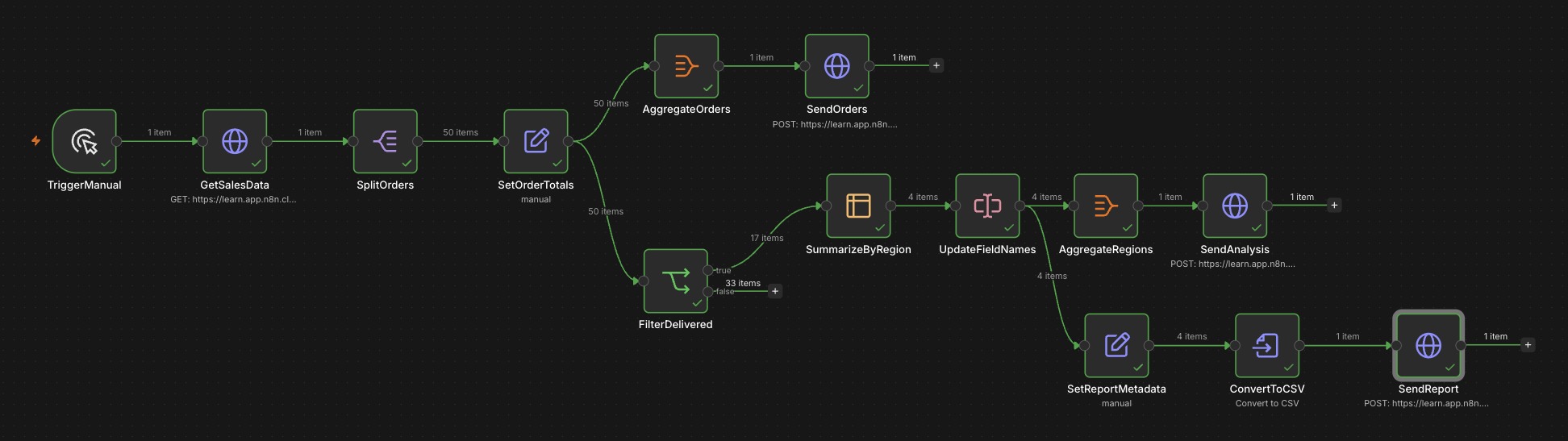
This is what a General Manager's homework looks like in 2026.
It's the final exercise from the first n8n course. Sales data comes in, gets split into orders, totals worked out, delivered orders filtered, summarised by region, and two reports go out the other end, one as a CSV. Fourteen steps, no code, about an hour.
It isn't running in a business yet. It's a training workflow with training data. But I now know what every box does, what breaks when the data isn't clean, and roughly what it would take to point this at a real system.
That's the point of doing the course myself rather than reading a summary. When I ran a business I signed off on systems I couldn't have drawn on a whiteboard. I don't think that works any more. The next round of management roles will need people who can read this diagram, argue with it, and know when a vendor is overselling.
I don't need to build every workflow. I need to understand the one I'm approving.
If you run a business, could you draw your order-to-report process like this? And would it have fourteen steps or forty?
What the fourteen boxes do, in plain language
- Get the data. One request pulls the sales file. Fifty orders come back in one lump.
- Split and total. The lump becomes fifty separate orders, each with a total worked out.
- Send the orders on. One branch bundles all fifty and posts them to the order system.
- Filter. The other branch keeps only delivered orders. Seventeen pass, thirty three don't.
- Summarise by region. Seventeen orders become four regional lines, renamed so a person can read them.
- Report twice. One copy goes out as analysis, one is stamped with a date and title, turned into a CSV and sent as the report.
Every arrow has a number on it. That is the bit I would want from any system I was approving: at each step, how many things went in and how many came out. When those numbers surprise you, that is where the process is broken, and it usually was before the software arrived.
 n8n101 Essentials: Your First WorkflowsCourse completed 2 October 2026, the first of the three n8n Foundations courses. See all accreditations →

General Manager, Brisbane. Builds with AI. More about me